
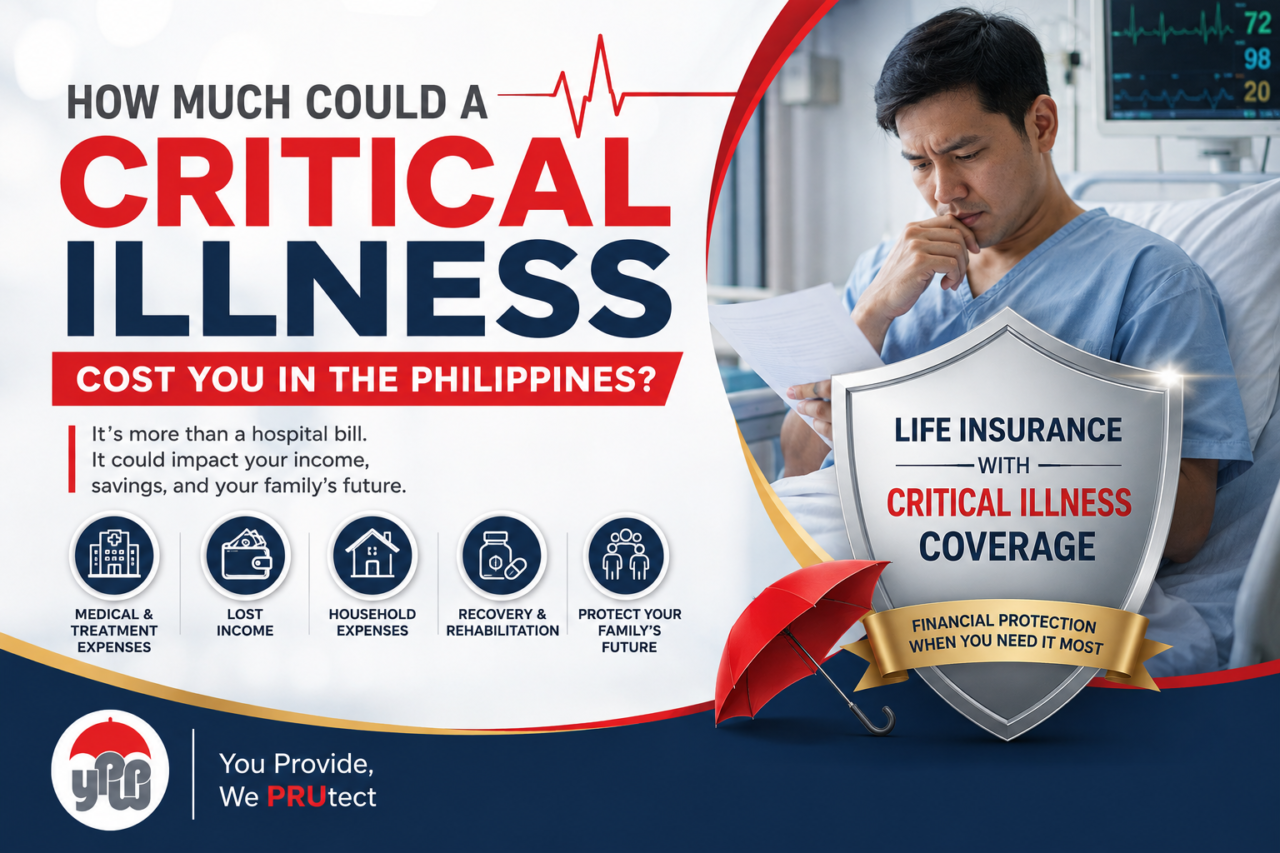
Main Question:
If I were diagnosed with cancer, suffered a heart attack, or had a stroke, how could it affect my finances—and how could my life insurance policy help?
When we think about critical illness, our first concern is usually our health.
But there is another question we should be asking:
What would happen to my finances if I became seriously ill?
In the Philippines, ischemic heart disease, cancer, and cerebrovascular diseases such as stroke are among the leading causes of death. These illnesses can affect more than our health. They can also affect our ability to work, earn an income, maintain our lifestyle, and continue meeting our financial responsibilities.
And the financial impact can be significant.
It isn’t only about the hospital bill.
There may also be medications, rehabilitation, follow-up treatments, caregiving expenses, and months of lost income.
So, how much could a critical illness potentially cost?
The Financial Cost of the Top 3 Critical Illnesses
There is no single price tag for treating a heart attack, cancer, or stroke.
The actual cost depends on the severity of the condition, treatment required, hospital, duration of confinement, and available health coverage.
The figures below should therefore be viewed as illustrative estimates, rather than guaranteed costs.
❤️ 1. Heart Attack: Potentially Around ₱1 Million
A heart attack can require emergency treatment, hospitalization, diagnostic procedures, medication, and potentially procedures such as angioplasty or other interventions.
Some estimates in the Philippines put the cost of treating a heart attack at around ₱500,000 to ₱1 million, depending on the circumstances.
But the financial impact doesn’t necessarily end when you leave the hospital.
You may still need medication, follow-up consultations, lifestyle adjustments, and ongoing medical monitoring.
And if your condition prevents you from working for several months, you could also lose a significant portion of your income.
So the question isn’t simply:
“How much will my heart attack treatment cost?”
It may also be:
“How will I support myself and my family while I recover?”
🎗️ 2. Cancer: From Hundreds of Thousands to Millions
Cancer is particularly difficult to put a single price tag on because treatment varies significantly depending on the type and stage of cancer.
Treatment may involve surgery, chemotherapy, radiation therapy, targeted treatment, medication, laboratory tests, and repeated consultations.
Some estimates put cancer treatment in the Philippines at ₱120,000 to more than ₱1 million, while certain types of cancer can cost considerably more.
For example, some estimates have placed treatment for lung cancer at around ₱2.78 million.
And cancer treatment may take months or even years.
That means the financial challenge isn’t necessarily one large hospital bill.
It could be a series of expenses that continue while you’re also trying to recover and maintain your household’s finances.
🧠 3. Stroke: Potentially Around ₱1.8 Million
A stroke can require emergency treatment, hospitalization, diagnostic procedures, medication, and potentially intensive care or surgery.
Some Philippine estimates put the potential cost of stroke treatment at around ₱1.2 million to ₱1.8 million, depending on the severity and treatment required.
But stroke can create another financial challenge:
recovery.
Some stroke survivors may require physical therapy, speech therapy, occupational therapy, medication, assistive equipment, or caregiving.
Recovery can take months or longer.
And if you are unable to work during that period, the financial impact can extend far beyond your medical expenses.
The Hospital Bill Is Only Part of the Problem
Let’s say you have ₱300,000 in savings.
You might feel that you’re reasonably prepared for an emergency.
But what happens if a serious illness causes you to:
- Spend hundreds of thousands of pesos on treatment
- Stop working for several months
- Continue paying rent or a housing loan
- Continue paying utilities and household expenses
- Pay for medications and follow-up consultations
- Support your family
- Delay your other financial goals
Your emergency fund may suddenly become your medical fund, income replacement fund, and household fund—all at the same time.
And once your savings are depleted, where would the remaining money come from?
You might have to consider borrowing money, using credit cards, selling investments, or using funds originally intended for another financial goal.
This is what makes critical illness a financial risk, not just a health risk.
But What About PhilHealth and My HMO?
PhilHealth and HMO coverage can be valuable parts of your healthcare plan.
They can help reduce eligible medical expenses.
But it’s important to understand what your existing coverage actually provides.
Your health coverage may have benefit limits, exclusions, room limits, network restrictions, or other conditions.
More importantly, medical coverage and income protection are not necessarily the same thing.
Even if a portion of your hospital bill is covered, what happens to your income if you cannot work?
Your rent or mortgage doesn’t stop.
Your family’s daily expenses don’t stop.
Your children’s education expenses don’t necessarily stop.
Your other financial commitments continue.
This is why it’s worth looking beyond the question:
“How much of my hospital bill is covered?”
And also ask:
“How will my family continue financially if I can’t work?”
Where Can Life Insurance Come In?
This is where your life insurance policy can potentially become more than a death benefit.
Depending on the policy and benefits attached to it, critical illness coverage can provide a cash benefit when you are diagnosed with a covered critical illness, subject to the policy’s terms and conditions.
Instead of being limited to reimbursement of specific medical expenses, a critical illness benefit may provide money that can help you address the broader financial impact of the illness.
For example, the benefit could potentially help with:
🏥 Medical and treatment-related expenses
It can help cover expenses that may not be fully covered by PhilHealth, an HMO, or other medical coverage.
💰 Lost income
If you need to take time away from work, the benefit can help provide financial support while you recover.
🏠 Everyday household expenses
Bills don’t stop when you become sick. A cash benefit can potentially help you continue meeting your family’s regular financial obligations.
💊 Recovery and rehabilitation
Depending on your situation, you may need medication, therapy, rehabilitation, transportation, or caregiving.
📈 Protecting your other financial goals
Instead of immediately using your children’s education fund, retirement savings, or investments, a critical illness benefit can provide another source of funds during a difficult period.
Think About the Financial Gap
Here’s a simple way to look at it.
Suppose you estimate that a serious illness could create the following financial needs:
Medical and treatment expenses: ₱700,000
Six months of lost income: ₱300,000
Household and recovery expenses: ₱300,000
That’s a potential financial need of:
₱1.3 million
Now suppose your savings and existing health coverage can potentially cover ₱500,000.
You could still have a:
₱800,000 financial gap
The numbers above are only an illustration. Your actual financial needs will depend on your circumstances.
But this exercise highlights an important question:
If I suddenly needed hundreds of thousands—or even millions—of pesos because of a critical illness, where would the money come from?
Critical Illness Coverage Can Be Part of the Solution
This doesn’t mean that critical illness coverage replaces your emergency fund, HMO, PhilHealth, or other financial resources.
Each has a different purpose.
Think of them as different layers of financial protection:
Emergency Fund
Helps you handle unexpected financial needs.
PhilHealth / HMO / Health Insurance
Can help cover eligible medical and healthcare expenses.
Critical Illness Benefit
Can provide a lump-sum benefit upon diagnosis of a covered critical illness, subject to the policy terms and conditions.
Life Insurance
Provides financial protection for your beneficiaries in the event of your death, subject to the policy terms and conditions.
Together, these can create a more comprehensive financial safety net.
Your Life Insurance Doesn’t Have to Be Only About Death
Many people think about life insurance this way:
“If I die, my family gets the money.”
That’s an important purpose of life insurance.
But depending on the policy, you may also be able to include benefits designed to provide financial support while you’re still alive.
Critical illness coverage is one example.
If you are diagnosed with a covered illness, the benefit can potentially give you access to funds when you may need them most.
And that money isn’t necessarily just about paying a hospital bill.
It can be about giving you financial breathing room while you focus on getting better.
Preparing Before the Diagnosis
We can’t predict whether we will have a heart attack, develop cancer, or suffer a stroke.
But we can prepare for the possibility.
Start by asking yourself:
How much do I have in emergency savings?
What does my PhilHealth and HMO coverage actually provide?
How much income would my family lose if I couldn’t work for six months or a year?
What financial responsibilities would continue while I recover?
Would I need to use my investments or borrow money to cover the gap?
And finally:
Does my current life insurance policy provide critical illness or other living benefits that could help?
These questions can help you determine whether your current financial protection is enough—or whether there are gaps that you should consider addressing.
Final Thoughts
A critical illness doesn’t only affect your body.
It can affect your income, savings, investments, financial goals, and the people who depend on you.
Heart attack.
Cancer.
Stroke.
We may not be able to predict when they will happen.
But we can prepare financially for the possibility.
Your emergency fund can help.
Your HMO and health coverage can help.
And depending on your life insurance policy, critical illness coverage can provide an additional financial resource when you need it most.
Because when you’re dealing with a serious illness, the last thing you want is to be forced to choose between focusing on your recovery and worrying about where the money will come from.
Your life insurance policy doesn’t have to be something your family benefits from only after you’re gone.
With the right living benefits, it can also be part of your financial protection while you’re still here.
The goal isn’t to expect a critical illness.
The goal is to be financially prepared if one comes.