
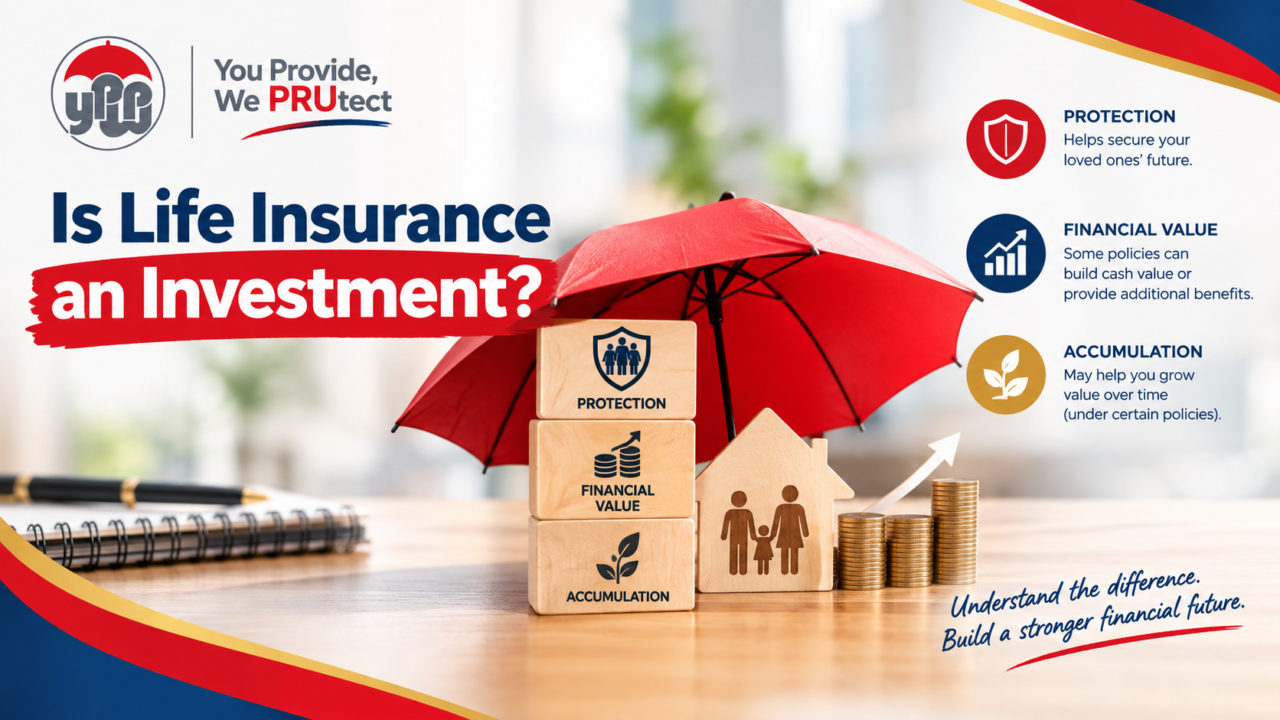
Should I consider life insurance an investment?
When people hear the word investment, they often think of stocks, mutual funds, real estate, or other assets that are expected to grow in value over time.
So where does life insurance fit?
Some life insurance policies can build cash value, accumulate funds, or provide benefits that go beyond the basic death benefit. Because of this, people sometimes describe life insurance as an “investment.”
But is it really?
The short answer is: life insurance is primarily protection, although certain types of life insurance can also provide financial value and accumulation features.
Understanding this distinction can help you decide whether a life insurance policy fits into your overall financial plan.
Life Insurance and Investments Serve Different Purposes
The easiest way to understand the difference is to look at their primary objectives.
Investments are generally designed to grow wealth.
When you invest in an asset, your primary goal is usually to earn a return. Depending on the investment, this may come through capital appreciation, dividends, interest, or other forms of income.
Life insurance is primarily designed to provide financial protection.
Its main purpose is to provide a benefit to your beneficiaries if you pass away, helping protect the financial goals and responsibilities you’ve worked hard to build.
For example, if you are the breadwinner in your family, life insurance can help provide financial support to your loved ones if you are no longer around to provide for them.
That’s fundamentally different from buying an investment with the primary goal of increasing your wealth.
Why Do Some People Consider Life Insurance an Investment?
The confusion usually comes from the fact that some types of life insurance have financial features beyond the death benefit.
Depending on the policy, these may include:
- Cash value
- Savings or accumulation features
- Dividends, where applicable
- Potential policy values over time
- Living benefits or other policy benefits
- The ability to access certain policy values, subject to the policy’s terms and conditions
These features can make a life insurance policy more financially versatile than simply thinking of it as a product that pays only when someone dies.
However, having a financial value does not automatically make a life insurance policy equivalent to an investment product.
Protection Should Come First
One of the most important questions to ask when considering life insurance is:
“What financial risk am I trying to protect against?”
If your answer is your family’s financial security, outstanding debts, future education expenses, income replacement, or other responsibilities, then you’re looking at life insurance from its intended perspective: protection.
For example, imagine a young professional who earns ₱50,000 per month and is helping support their family.
Their income is an important financial asset.
If something happens to them, their family could suddenly lose that income.
Life insurance can help transfer part of that financial risk to an insurance company.
In this situation, the value of the policy isn’t simply about how much money it may accumulate. Its most important value may be the financial protection it provides from day one, subject to the policy’s terms and conditions.
But What About Policies That Build Cash Value?
This is where things become more interesting.
Certain permanent life insurance policies may have a cash value or other policy values that can potentially grow over time.
This means that while the policy provides life insurance protection, it may also accumulate financial value.
For some people, this can make sense as part of a broader financial strategy.
However, it’s important to understand that cash value should not automatically be compared with the returns of a traditional investment.
There may be costs, charges, insurance expenses, surrender considerations, and other factors that affect the policy’s value.
The actual values will also depend on the specific policy and its terms.
That’s why it’s important to look at the policy illustration and understand what is guaranteed versus what is non-guaranteed.
Life Insurance Is Not a Replacement for Investing
Another common misconception is:
“If I have life insurance, I don’t need to invest.”
That’s generally not the right way to look at it.
Life insurance and investments can work together because they solve different financial problems.
For example:
Life insurance can help protect your financial plan.
Investments can help you build and grow wealth.
Think of it this way:
Insurance protects what you’ve built. Investments help you build more.
A well-rounded financial plan may include both.
What About Term Insurance?
The distinction becomes even clearer with term life insurance.
Term insurance generally provides life insurance coverage for a specified period.
Its primary purpose is protection.
It typically does not have the same cash-value component associated with certain permanent life insurance policies.
This makes it easier to see that life insurance doesn’t have to be an investment to be financially valuable.
In fact, one of the biggest benefits of insurance can be the financial protection it provides when you need it most.
So, Is Life Insurance an Investment?
The better answer is:
It depends on what type of life insurance you’re talking about and how you’re using it.
Some life insurance policies have features that allow them to accumulate financial value over time. However, that doesn’t mean the policy should be treated exactly like a traditional investment.
A more accurate way to think about it is:
Life insurance is primarily a protection tool, and certain policies can also have financial value that may complement your broader financial strategy.
This distinction matters because choosing a policy solely because you expect it to generate returns may cause you to overlook its most important purpose: protecting your financial goals and the people who depend on you.
Look at the Bigger Financial Picture
Instead of asking:
“Is life insurance an investment?”
A better question may be:
“What role should life insurance play in my financial plan?”
For one person, the priority may be income protection.
For another, it may be protecting a family’s financial future.
Someone else may want a policy that combines protection with additional financial features.
The right approach depends on your age, income, financial responsibilities, goals, existing investments, and overall financial situation.
There isn’t one type of policy that’s automatically right for everyone.
The Bottom Line
Life insurance shouldn’t simply be viewed as an investment.
Its primary purpose is protection.
However, certain life insurance policies can provide financial value beyond the basic death benefit, which may make them a useful component of a broader financial plan.
The key is to understand what you’re buying and why you’re buying it.
Don’t choose a life insurance policy simply because someone calls it an “investment.”
Instead, ask:
- What protection does this policy provide?
- What benefits can I receive while I’m alive?
- Does the policy build financial value?
- Which values are guaranteed?
- Which values are non-guaranteed?
- What costs and charges apply?
- How does this fit with my other financial goals and investments?
When you understand the role of your policy, you can make a more informed financial decision.
Life insurance doesn’t have to compete with your investments.
It can be one of the tools that helps protect the financial future you’re working to build.